My App

3. Angular Acceleration

-----

α=ΔωΔt\alpha = \dfrac{\Delta \omega}{\Delta t}


limΔt0ΔωΔt=dωdt\lim_{\Delta t \to 0} \dfrac{\Delta \omega}{\Delta t} = \dfrac{d\omega}{dt}

Acceleration

A vector quantity that describes how the angular velocity of an object changes with time

For an object moving in a circle, acceleration can be decomposed into two components

  • Tangential Acceleration — changes the magnitude of the angular velocity
  • Radial (Centripetal) Acceleration — points toward the centre of the circular path and changes the direction of the velocity
a=(atac)\vec{a} = \begin{pmatrix} a_t \\ a_c \end{pmatrix}

Deriving ata_t and aca_c

v=ωrv = \omega r

take the derivative with respect to time

dvdt=dωdrr+ωdrdt\dfrac{dv}{dt} = \dfrac{d\omega}{dr}r + \omega\dfrac{dr}{dt}

this can be rewritten as

a=αr+ωdrdta = \alpha r + \omega\dfrac{dr}{dt}

Angular Acceleration (aca_c)

ac=αra_c = \alpha r

Tangential Acceleration (a_t)

at=ωdrdta_t = \omega\dfrac{dr}{dt}


Contants Angular Acceleration

α=constant  dω=αdt\alpha = \text{constant} \\ \; \\ d\omega = \alpha dt

integrate both sides

ω0ωdω=0tαdt\int_{\omega_0}^{\omega} d\omega = \int_{0}^{t} \alpha \, dt   ωω0=αt\; \\ \omega - \omega_0 = \alpha t ω=ω0+αt\boxed{\omega = \omega_0 + \alpha t}

if we solve for θ\theta

dθdt=w0+αt\dfrac{d\theta}{dt} = w_0 + \alpha t θ0θdθ=0t(ω0+αt)dt\int_{\theta_0}^{\theta} d\theta = \int_{0}^{t} (\omega_0 + \alpha t)\, dt θθ0=ω0t+12αt2\theta - \theta_0 = \omega_0 t + \frac{1}{2}\alpha t^2 θ=θ0+ω0t+12αt2\boxed{\theta = \theta_0 + \omega_0 t + \frac{1}{2}\alpha t^2}


Representing ω\omega

Angular velocity can be denoted by the right hand rule
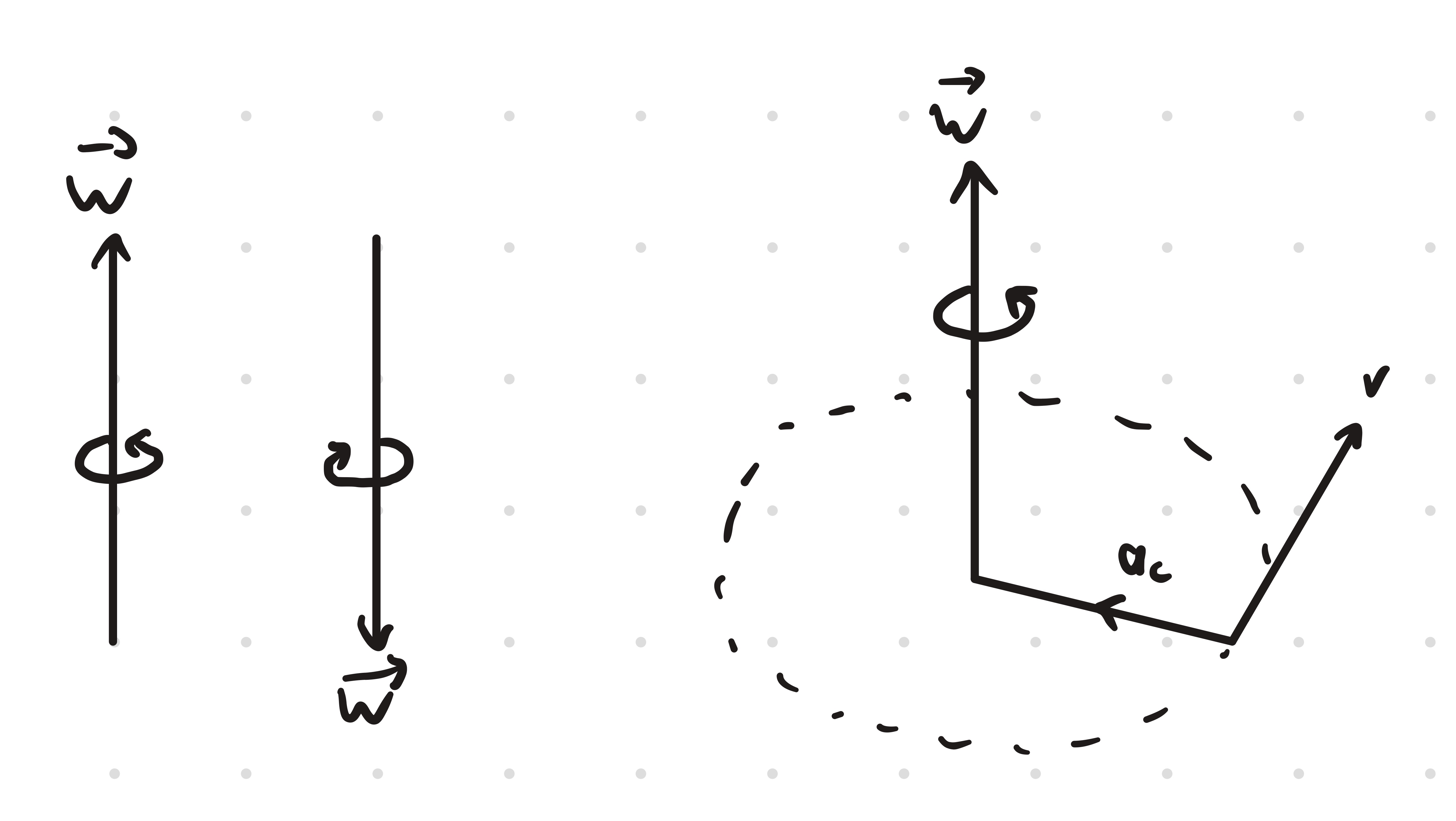
Circular Motion